Parker Foundation Takes Over Hastings and Removes Donatti
Lessons in ChemistryThe Parker Foundation’s takeover of the Hastings Research Institute ends Dr. Donatti’s control of its Chemistry department and brings Elizabeth Zott’s stolen research into the open. What begins as an unannounced visit becomes an institutional reckoning: the foundation presents a termination notice, Miss Frask emerges from a previously subordinate position as head of Personnel, and Elizabeth is offered the directorship that Dr. Donatti is about to lose.
Causes and Background
The confrontation has a history in the unequal recognition of Elizabeth’s scientific work. At the institute, she was regarded as an innovator whose progress was undeniable, yet her contributions went unrecognized. Complaints about her were frequent: she voiced her opinions, insisted that her name appear on her own papers, and refused to make coffee. The catalogue of objections makes clear how professional credit and workplace expectations were entangled. Her abiogenesis project had received approval only because a wealthy investor insisted on funding it, while colleagues could still wonder whether its progress belonged to Elizabeth or to Calvin Evans.
Dr. Donatti’s published paper makes that struggle over credit concrete. He had previously dismissed the article as nothing earth-shattering, but Elizabeth recognized the work in it as her own. Reading it twice, she confirmed that it had been taken directly from her files. Dr. Boryweitz was listed as a co-contributor; when Elizabeth confronted him, he pleaded that he needed his job. The scene exposed more than a dispute over attribution: the institute’s publication process had allowed Elizabeth’s research to appear under other people’s names, while the people implicated had reasons to protect their positions.
A separate act of accountability began when Miss Frask wrote to Life magazine. As Wilson later explains, that letter prompted the Parker Foundation to look more closely at the Hastings Research Institute. The foundation had recently acquired a majority share and, after its review, decided to take over the institution. The visit therefore joins two forms of scrutiny: Elizabeth’s claim that Dr. Donatti stole her work and the foundation’s wider concerns about how the institute was being managed.
The Unannounced Visit
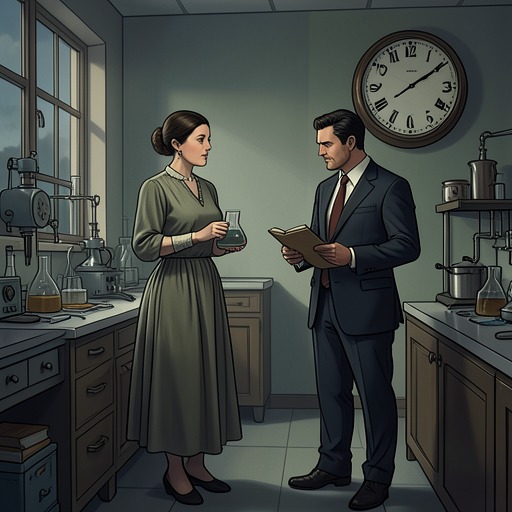
The visitors assemble in the laboratory. Miss Frask offers to make fresh coffee while the Parker Foundation explains its plans, but before she has gone halfway across the room, the laboratory door opens and Dr. Donatti arrives. He has heard that Wilson is in town and says he has come over despite still being on vacation. His cordial greeting falters when he sees Miss Frask, then Avery Parker, and finally Elizabeth.
Wilson makes clear that the visit was meant to catch Dr. Donatti off guard. He links that deliberate surprise to the conduct under investigation, naming both the alleged misappropriation of Parker Foundation funds and the theft of Elizabeth’s work. Elizabeth raises her eyebrows when Wilson identifies himself as her lawyer. Dr. Donatti starts to protest that he has been given a misleading account, but Avery Parker moves the meeting from argument to decision: she produces a single-page document headed Termination Notice and asks for his signature.
The paper is presented as the practical consequence of a completed review, not as the beginning of negotiations. Wilson tells Dr. Donatti that the foundation has acquired a majority share in the institute and is taking it over. The explanation includes mismanagement, faked test results, and plagiarism. Dr. Donatti barely attends to the list. His attention turns instead to the fact that this is Calvin Evans’s old laboratory, a detail that connects the present institutional crisis to the research history Elizabeth and Calvin shared.
A Change in Authority
Miss Frask says that cuts are being made. Dr. Donatti dismisses her by pointing out that she is a secretary who has been fired, but Wilson reveals that the foundation has made her the new head of Personnel. The reversal is immediate and specific: the person Dr. Donatti treats as an insignificant former employee now has an official role in the reorganization, while his own authority is being removed.
Avery Parker then says that the foundation has decided to offer the Chemistry directorship to someone else and nods toward Elizabeth. Elizabeth, surprised, takes a step back. Dr. Donatti objects emphatically, but Avery clarifies that she is not asking him to decide whether Elizabeth should receive the job. If he wants the question of his employment left to someone who knows his work, Avery indicates Elizabeth again. The offer places the decision in the hands of the scientist whose work he appropriated, although the scene does not establish whether Elizabeth accepts the position.
The room’s attention turns to Elizabeth. She stands with her hands on her hips, leans toward Dr. Donatti, and studies him in silence as if examining something under a microscope. After two beats, she leans back, as though she has reached her conclusion. She hands him a pen and tells him he is not smart enough. The remark is her final judgment on the man who had published her work and now faces dismissal; it does not replace the formal notice, but it gives the institutional reversal a personal point of closure.
Consequences and Significance
The event redistributes both authority and recognition. The Parker Foundation’s acquisition gives it the power to remove Dr. Donatti, while Miss Frask’s appointment overturns his assumption that she has no standing in the institution. Elizabeth, whose insistence on being credited had previously helped make her a target of complaints, is now offered leadership of the department. The shift is consequential, but it remains an offer rather than a confirmed appointment, and the scene leaves her response unresolved.
The takeover also connects the theft of a particular body of research to broader failures in institutional oversight. Dr. Donatti’s paper had carried Elizabeth’s work into a scientific journal without proper credit; the foundation’s investigation identifies plagiarism alongside misused funds, faked results, and sloppy management. Miss Frask’s letter is the stated reason the foundation began examining the institute, while Elizabeth’s position as the scientist whose work was taken makes the cost of those failures unmistakable.
The confrontation’s sharpest reversal is not simply that a powerful director loses his job. It is that the people he had treated as subordinate or expendable become central to the new arrangement: Miss Frask is entrusted with Personnel, and Elizabeth is considered for the Chemistry directorship. The pen and termination notice formalize Dr. Donatti’s removal; Elizabeth’s restrained pause before her assessment gives the ending its final measure of accountability.